Do Buyers Sign a Broker Agreement?
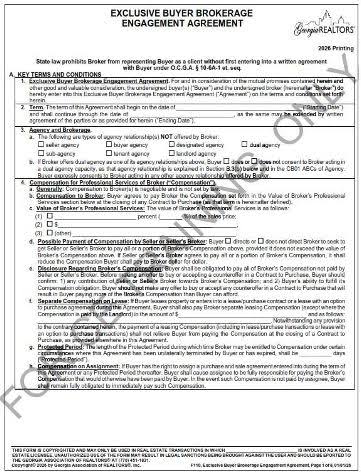
Yes. Georgia agents are now required to have a signed buyer brokerage agreement in place before showing you a home, following changes tied to the National Association of REALTORS® settlement. In practice, that means your agent will ask you to sign the GAR F110 Exclusive Buyer Brokerage Engagement Agreement (or a non-exclusive version) at or before your first showing. The agreement spells out how long you’re working together, how your agent gets paid, and what they’re obligated to do for you — and nearly every term in it is negotiable before you sign.
If you’re starting your home search in Milton, Alpharetta, Johns Creek, or Roswell, you’ve probably already run into this. You call an agent about a listing, and before you ever set foot in the house, you’re handed a form to sign. It catches a lot of buyers off guard, and it’s become one of the most common questions I get from people touring their first home in this market.
Why Every Georgia Agent Is Asking You to Sign First
This isn’t a local quirk or a pushy broker’s idea. It’s the practical result of a national legal settlement.
In 2024, the National Association of REALTORS® settled a set of commission-related lawsuits, and one of the required changes took effect that August: a real estate agent working with a buyer has to have a written agreement in place before they can show that buyer a home. Before you fall in love with a house, your agent legally has to get this signed — it’s not optional, and it’s not specific to any one brokerage.
In Georgia, that agreement is the GAR F110 Exclusive Buyer Brokerage Engagement Agreement, published by the Georgia Association of REALTORS® and updated most recently at the start of 2026. Some agents use a non-exclusive version for a single showing or an open house visit, which limits the commitment to that one property. Either way, the underlying rule is the same: no signed agreement, no private showing.
If this feels like a lot of paperwork before you’ve even seen a kitchen, you’re not wrong — but it’s worth understanding rather than skipping past. This agreement now defines your entire working relationship with your agent, including how they’re compensated.
What You’re Actually Agreeing To
The GAR F110 isn’t a form you should sign without reading. It covers four things that materially affect your home search:
- Duration — the agreement sets a specific time period, commonly 30, 60, or 90 days, though it’s negotiable. A shorter term lets you test the relationship before committing longer; a longer term avoids re-signing every few weeks if you’re actively house hunting.
- Compensation — this is the section that changed the most. Before 2024, buyer agent commission was almost always built into the listing and paid by the seller automatically. Now, the agreement has to state explicitly how your agent is compensated — a flat fee, an hourly rate, or, most commonly, a percentage of the sale price.
- Exclusivity and scope — an exclusive agreement means you’re committing to work with that agent for the term of the contract. A non-exclusive version lets you work with multiple agents but usually limits your agent’s obligations to a specific property or showing.
- Termination — look for the cancellation terms. A reasonable agreement should spell out how you can end the relationship if it’s not working, rather than locking you in for the full term regardless.
In practice, most sellers in Milton, Alpharetta, Johns Creek, and Roswell are still offering buyer agent compensation through the MLS, and that amount typically covers what’s stated in your agreement. But the agreement should spell out what happens if a seller offers less than your agent’s stated rate — whether you’d owe the difference, or your agent absorbs it. And if you’re not sure you’re ready to commit to one agent yet, ask specifically for a non-exclusive or single-showing agreement rather than signing the full exclusive version on the spot.
What Happens If You Don’t Sign
You can still walk through an open house without signing anything — that’s the one carve-out in the rule. Open houses are hosted by the listing agent, who represents the seller, not you, so no buyer agreement is required to attend.
But the moment you want a private showing, or you want an agent representing your interests rather than the seller’s, you’ll need a signed agreement first. This is also why it matters who you choose to work with before you start touring — the decision of whether you’re ready to buy at all and who’s guiding you through it are now connected from the very first showing, not after you’ve found “the one.”
For buyers considering co-buying with a partner, friend, or family member, this matters even more — everyone whose name will be on the offer should understand and, in most cases, sign the same agreement, so there’s no confusion later about who your agent represents.
Questions Worth Asking Before You Sign
- What is the exact commission percentage or fee, and how is it calculated?
- What happens if the seller’s offered compensation is lower than my agent’s rate?
- Can I cancel this agreement, and how much notice does that require?
- Does this agreement apply to one property, a specific search area, or every home I might buy during this period?
- What exactly is my agent obligated to do for me during this term?
A good agent will walk through every one of these before asking for a signature — not rush you past them to get to the showing.
Frequently Asked Questions
What is a buyer broker agreement in Georgia?
It’s a written contract — most commonly the GAR F110 Exclusive Buyer Brokerage Engagement Agreement — that a real estate agent must have signed with a buyer before showing that buyer a home. It sets the length of the working relationship, how the agent is compensated, and what the agent is obligated to do.
Can I still visit an open house without signing anything?
Yes. Open houses are hosted by the seller’s agent, so no buyer agreement is required to attend one. You’ll need a signed agreement once you want a private showing or want an agent representing your interests specifically.
How long does a buyer broker agreement last?
Terms are negotiable, but 30, 60, and 90-day agreements are all common in the Milton and Alpharetta area. You can ask for a shorter term or a single-property version if you’re not ready to commit to a longer exclusive relationship.
Who pays my agent’s commission if I sign a buyer broker agreement?
Most sellers in this market still offer buyer agent compensation through the MLS, which typically covers your agent’s stated rate. Your agreement should specify what happens if a seller offers less than that rate.
Can I negotiate the terms of a buyer broker agreement before I sign?
Yes. Duration, compensation, exclusivity, and cancellation terms are all negotiable. Don’t assume the first draft an agent hands you is the only version available — ask questions and request changes before you sign.
Bottom Line
Georgia’s buyer brokerage agreement requirement isn’t a trap or a sales tactic — it’s a legally required document that protects both you and your agent by putting the terms of your working relationship in writing before you start touring homes. Read it, negotiate the parts that matter to you, and make sure you understand exactly what you’re committing to and how your agent gets paid.
Every buyer’s situation is a little different — your timeline, your price range, and how sure you are about the agent you’re working with all affect what terms make sense for you. If you’re getting ready to start touring homes in Milton, Alpharetta, Johns Creek, or Roswell, I’m happy to walk you through exactly what you’d be signing and why, with no pressure to commit on the spot. Reach out anytime.
The information contained, and the opinions expressed, in this article are not intended to be construed as investment advice. The author does not guarantee or warrant the accuracy or completeness of the information or opinions contained herein. Nothing herein should be construed as investment advice. You should always conduct your own research and due diligence and obtain professional advice before making any investment decision. The author will not be liable for any loss or damage caused by your reliance on the information or opinions contained herein.

Shanaz Kanga
Shanaz Kanga is a REALTOR® with Harry Norman, REALTORS®, serving Milton, Alpharetta, Johns Creek, Roswell, and the greater North Atlanta metro. Before real estate, she spent years working as an architect and in interior and UX design, and she brings that same eye for space, flow, and function to how she guides clients through buying and selling. She has spent nearly a decade living and working in the Atlanta market and is a member of the Atlanta Realtors Association.


Leave a Reply